Since I don't have a huge amount of yarn on the spindle for my Spindlers June challenge yarn, I decided it was the perfect opportunity to finally try a plying bracelet.
A common method of plying, especially among spindle spinners, is to ply from both ends of a center-pull ball. Essentially, what you are doing is folding your single in half and plying it from both ends to the middle of the single. There are arguments that can be made either for or against the idea of plying a single against itself, but especially for small lengths of yarn or for samples, it is the simplest method of plying.
There are several different ways of setting up this process: (1) winding a center-pull ball manually, (2) using a ball-winder, (3) winding a center-pull ball on a nostepinne and leaving the yarn on the nostepinne during plying, and (4) winding a plying bracelet on your hand.
I've tried the first three methods before, and I have to admit, I'm not a fan. There are spinners who swear by these methods of plying, but I have found it a frustrating process with lots of tangled yarn, so until now I only swear at these methods, not by them. The more you ply, the looser the ball becomes and the greater your chances for tangles to form in the ball. But I haven't yet tried using a plying bracelet and before I throw up my hands in utter surrender with regards to plying a single back on itself, I want to give it a try. I especially like the idea of having a simple method of plying that doesn't involve any tools except my hands.
So here goes..
In my quest for plying bracelet self-education, I went to my home library and read descriptions of the method in Amelia Garripoli's "Productive Spindling" and Priscilla Gibson-Roberts "Spinning in the Old Way." Oddly enough, their descriptions are mirror images of each other. Garripoli calls the method "Andean Plying Bracelet" and has the wraps of the bracelet form on the palm of the hand. Gibson-Roberts calls it "Peruvian hand-wrap plying" and forms the wraps on the back of the hand.
I decided to go with Garripoli's instructions, because it seemed like it would be easier to slip my finger out of the wraps if they are on my palm, rather than the back of my hand, when I come to that part of the process. You'll see what I mean.
To start, decide which hand is going to hold the yarn. I chose to wrap my left hand. I secured the end of my yarn to the inside of my left arm. I "cheated" by using a bit of tape on my arm:
Next, I brought the yarn over my palm and around my middle finger.
The yarn is then wrapped below the thumb and around the back of the hand to the other side. It comes back up from the pinky side of the palm to wrap around the middle finger again, then back down to the pinky side of the palm.
From there, wrap the yarn across the back of the hand to the thumb side, up around the middle finger, back to the thumb side.
Please note that when you wrap around the middle finger, you'll be alternating the sides of the finger that is wrapped. From the pinky side, wrap around the left side of the finger (palm facing you), and from the thumb side, wrap around the right side of the finger (again, palm facing you).
Repeat the process until all of the single yarn is wound around your hand. Some folks create beautiful wraps... mine is fairly ugly, but very functional:
Finally, you need to gently push the yarn wrapped around the bottom of your palm up a bit, to ease the tension just enough where you can slip your finger out of the loop of yarn that is wound around it. This is why I chose to wrap the single against my palm instead of the back of my hand. It was much easier to gently remove my finger from the loop in this direction. The key to creating the plying bracelet is using enough tension on the yarn during the wrapping process that it doesn't tangle back on itself, but not so much that you can't easily slip your finger out of the loop.
Once your finger is removed from the loop, the yarn becomes a circle that you gently ease back down to your wrist. Keep track of the ends, secure them back to the spindle, and start plying!
Using a plying bracelet is the first time I have enjoyed the process of plying a single back on itself to create a final 2-ply yarn. I didn't struggle with yarn tangling back on itself, and the plying process went very quickly and smoothly. I have now discovered my vastly preferred method for this kind of plying, and I will never bother with center-pull balls or a nostepinne for plying like this again.
I can see that the one potential problem is that you do need a bit of uninterrupted time for this method. Once the yarn is on your hand, you're more or less stuck with it until you're finished with plying. MNLacer commented on last Friday's post about this issue, and also suggested that in a pinch, you can ease the bracelet around another object like a paperback book if you are forced to take a break during plying. I will definitely keep that in mind!
Here is the spindle full of plied yarn:
Now I'm off to wind the yarn into a skein and wash it!
Monday, June 18, 2012
Friday, June 15, 2012
Finally, yarn!
I have finally ended my dry spell of fiber activity! Phew.
I spent a little bit of time on spinning during the past two days and managed to spin all of the fiber for my entry into the Spindlers group challenge for June. Here is my "Undercover" yarn so far:
I didn't worry about anything fancy with this single. I spun it as quickly as possible, using as long a draw as I could manage. This translates to a somewhat inconsistent single in terms of diameter, but it should emphasize the fuzziness and bounciness of the fiber in the final yarn.
I'm considering my plying options with this single. There's not a lot of yarn, so in order to maximize it, I think I'll go with a 2-ply. Now I need to decide if I want to wind the single on a couple of bobbins, or maybe I should try an Andean plying bracelet for the first time.
I spent a little bit of time on spinning during the past two days and managed to spin all of the fiber for my entry into the Spindlers group challenge for June. Here is my "Undercover" yarn so far:
I didn't worry about anything fancy with this single. I spun it as quickly as possible, using as long a draw as I could manage. This translates to a somewhat inconsistent single in terms of diameter, but it should emphasize the fuzziness and bounciness of the fiber in the final yarn.
I'm considering my plying options with this single. There's not a lot of yarn, so in order to maximize it, I think I'll go with a 2-ply. Now I need to decide if I want to wind the single on a couple of bobbins, or maybe I should try an Andean plying bracelet for the first time.
Wednesday, June 13, 2012
1,536 Bricks
Yarn? What's that?
It's been so long since I last made or used yarn that I am definitely showing signs of irritability from fiber withdrawl. I was bound & determined to either ply my mill ends yarn or start spinning my June Spindlers challenge yarn over the weekend. Instead, my major accomplishment of the past weekend was arranging approximately 1,536 bricks on our newly improved patio.
I might have had a few bad moments of hating this project. I might have considered having my own version of a toddler tantrum. More than once. Maybe. But in the end, I gritted my teeth, got through it, and I'm really happy with the final product of this patio makeover. And now I will have a beautiful space to enjoy spinning outdoors for the rest of the summer.
The old patio was made from concrete blocks (circa 1958) that were crumbling and unlevel due to inadequate water drainage (fixed that problem with new gutters a few years ago) and a huge maple tree with strong roots that grows next to the patio (we choose to live around this problem). My husband and I had discussed several options regarding the patio problem, and thought we had settled on eventually constructing some kind of deck. However, we recently discovered a patio resurfacing product that is made from recycled tires and decided to go with this instead.
So, my husband, his grandfather, and I spent the weekend working on the patio. The project started with prepping the area with removing the worst of the old blocks and patching with concrete:
The next step was setting up the border and starting to lay down the grid for the bricks:
And then I got to work filling the bricks into the grid. This was initially fun work, but it quickly deteriorated into a hated task because I had to
However, the dogs loved spending the weekend outdoors and amused themselves with games like tug of war:
And now the final summary...
Before:
Two days, hours & hours of work, and 1,536 bricks later:
I have promised myself some uninterrupted spinning time this week. I have earned it.
It's been so long since I last made or used yarn that I am definitely showing signs of irritability from fiber withdrawl. I was bound & determined to either ply my mill ends yarn or start spinning my June Spindlers challenge yarn over the weekend. Instead, my major accomplishment of the past weekend was arranging approximately 1,536 bricks on our newly improved patio.
I might have had a few bad moments of hating this project. I might have considered having my own version of a toddler tantrum. More than once. Maybe. But in the end, I gritted my teeth, got through it, and I'm really happy with the final product of this patio makeover. And now I will have a beautiful space to enjoy spinning outdoors for the rest of the summer.
The old patio was made from concrete blocks (circa 1958) that were crumbling and unlevel due to inadequate water drainage (fixed that problem with new gutters a few years ago) and a huge maple tree with strong roots that grows next to the patio (we choose to live around this problem). My husband and I had discussed several options regarding the patio problem, and thought we had settled on eventually constructing some kind of deck. However, we recently discovered a patio resurfacing product that is made from recycled tires and decided to go with this instead.
So, my husband, his grandfather, and I spent the weekend working on the patio. The project started with prepping the area with removing the worst of the old blocks and patching with concrete:
The next step was setting up the border and starting to lay down the grid for the bricks:
Oliver thinks, "I thought you always said no digging??"
And then I got to work filling the bricks into the grid. This was initially fun work, but it quickly deteriorated into a hated task because I had to
re-do the first big area twice in order to get the darker red bricks spread out randomly in the pattern in the right proportion to the other two colors. Having hot and humid weather didn't sweeten my mood either.
And now the final summary...
Before:
Two days, hours & hours of work, and 1,536 bricks later:
I have promised myself some uninterrupted spinning time this week. I have earned it.
Wednesday, June 6, 2012
June 2012 Spindlers Challenge: "Undercover"
I've missed the last two months of Spindlers challenges, which is a shame because the themes were fun, but I'm not missing the June 2012 challenge! The theme is "Undercover." My immediate association is with cops & criminals and superheroes & supervillains. It occured to me that the ultimate undercover character is Mystique from the X-men comic, and I just happen to have some fiber in my stash that would be perfect to use for a yarn inspired by her.
Here's Mystique (as featured in the X-men movies):
and here's my fiber:
This fiber is leftover from a dye class I took in 2010. It's a wool-mohair mix and should spin beautifully. I decided to keep with the blue theme and use a 1.3 ounce blue spindle for this yarn:
(Refresher info: The Spindlers group on Ravelry has monthly theme challenges where you start & finish a yarn within that calendar month using a spindle. Click on the discussion thread for the June challenge if you would like to follow it.)
Here's Mystique (as featured in the X-men movies):
and here's my fiber:
This fiber is leftover from a dye class I took in 2010. It's a wool-mohair mix and should spin beautifully. I decided to keep with the blue theme and use a 1.3 ounce blue spindle for this yarn:
(Refresher info: The Spindlers group on Ravelry has monthly theme challenges where you start & finish a yarn within that calendar month using a spindle. Click on the discussion thread for the June challenge if you would like to follow it.)
Tuesday, June 5, 2012
Yarn? No. Garden? Yes.
My fiber time for the last several days has been sacrificed to the garden gods. I love having a pretty yard, and I love having my own homegrown fresh fruits & vegetables, so I understand the necessary trade-off between yarn and garden time. My fingers are getting antsy for fiber, though, so I know I will make sure to do something with yarn this week to appease them.
But if I couldn't play with fiber this past weekend, at least I got to play in the dirt.
In one corner of the yard, we have our perennial garden where the grapevines are flourishing on the arbor. The vines are loaded with baby bunches of grapes and I will have more than enough to make homemade grape jelly this year. Behind the arbor, the sour cherry tree is also bulging with fruit that is just starting to blush with red.
I'm particularly pleased with the windowboxes on the shed this year. My husband and I picked out different purple, magenta & white flowers for them:
On the other side of the yard is the vegetable garden. The perennials that border the garden space are doing very well - the strawberry patch is happy, the rhubarb is huge, the mint is growing like weeds, and the raspberry canes have the best crop of berries started on them that we've had in years. Apparently they appreciated the wet spring more than I did. Of course they didn't have to constantly wipe mud from dog paws for weeks on end, either.
The vegetable garden is planted! This always feels like the biggest accomplishment of early summer. This year's line-up: hot peppers, turnips, radishes, green beans, zucchini, sweet corn, onions, 6 different kinds of tomatoes, eggplant, pumpkins, basil, & parsley. Summer should be very, very tasty.
It doesn't look all that spectacular now, but give it a couple of months and it will be a jungle of vegetable plants. It will be fun to have before & after photos to compare between planting weekend and the beginning of harvesting. Also, that black plastic-looking material on the garden? It's not very attractive, but it is wonderful stuff. It's a biodegradeable material that will prevent weeds and help the plants retain moisture. I won't have to spend hardly any time at all on weeding... and you know that means more time for spinning & knitting!
Lastly, I potted the thyme and rosemary this year, instead of putting them in the garden. I plan to bring them indoors for the winter, so I can continue to enjoy using fresh herbs in the kitchen when it's cold and snowy outside:
But if I couldn't play with fiber this past weekend, at least I got to play in the dirt.
In one corner of the yard, we have our perennial garden where the grapevines are flourishing on the arbor. The vines are loaded with baby bunches of grapes and I will have more than enough to make homemade grape jelly this year. Behind the arbor, the sour cherry tree is also bulging with fruit that is just starting to blush with red.
I'm particularly pleased with the windowboxes on the shed this year. My husband and I picked out different purple, magenta & white flowers for them:
On the other side of the yard is the vegetable garden. The perennials that border the garden space are doing very well - the strawberry patch is happy, the rhubarb is huge, the mint is growing like weeds, and the raspberry canes have the best crop of berries started on them that we've had in years. Apparently they appreciated the wet spring more than I did. Of course they didn't have to constantly wipe mud from dog paws for weeks on end, either.
The vegetable garden is planted! This always feels like the biggest accomplishment of early summer. This year's line-up: hot peppers, turnips, radishes, green beans, zucchini, sweet corn, onions, 6 different kinds of tomatoes, eggplant, pumpkins, basil, & parsley. Summer should be very, very tasty.
It doesn't look all that spectacular now, but give it a couple of months and it will be a jungle of vegetable plants. It will be fun to have before & after photos to compare between planting weekend and the beginning of harvesting. Also, that black plastic-looking material on the garden? It's not very attractive, but it is wonderful stuff. It's a biodegradeable material that will prevent weeds and help the plants retain moisture. I won't have to spend hardly any time at all on weeding... and you know that means more time for spinning & knitting!
My husband's rose garden is growing beautifully this year. The roses loved the mild winter and wet spring, too:
Friday, June 1, 2012
Thank you Mr. Postman!
June is starting with a bang! My copy of Spin-Off, Summer 2012 arrived in the mail. I always dance a happy jig when it shows up:
I try really hard to enjoy the magazine as slowly as possible, only letting myself read one or two articles at a time. It's hard not to devour it in a single sitting, but I try.
While I always enjoy the magazine, some of the Spin-Off quarterly issues appeal to me more than others. This summer's publication might be destined to be one of my favorites. Perhaps it's because there is so much spindle-related information in this issue, and I love using spindles. There are two articles that pertain to support spindles, which I have barely used and gaining some expertise with support spindling is on my fiber to-do list.
A couple of other articles talk about twist - one focuses on how to overply yarn for specific kinds of durability, and another deals with creating functional singles yarn. I've been thinking about these topics in depth on my own for quite a while now, so these articles dovetailed well for me and confirmed what I've been working on with my own yarn. I haven't played much with singles yarn yet, and it's definitely something I want to do with my craft.
Another highlight that's waiting for me is an article from Deb Robson that discusses the relationship between fiber diameter, crimp, and fiber softness. I am a total wool geek, so this article is crack for me. With much teeth-gritting, I'm saving this article for last. I will make it my reward for some dreaded task.
And in other news, those bobbins of mill-ends singles are still on the lazy kate waiting to be plied. What can I say? Memorial weekend was busy. (sigh)
(I don't intend this post as an advertisement, but if you want your own copy of the magazine and you can't find it locally, here is the Interweave store link.)
I try really hard to enjoy the magazine as slowly as possible, only letting myself read one or two articles at a time. It's hard not to devour it in a single sitting, but I try.
While I always enjoy the magazine, some of the Spin-Off quarterly issues appeal to me more than others. This summer's publication might be destined to be one of my favorites. Perhaps it's because there is so much spindle-related information in this issue, and I love using spindles. There are two articles that pertain to support spindles, which I have barely used and gaining some expertise with support spindling is on my fiber to-do list.
A couple of other articles talk about twist - one focuses on how to overply yarn for specific kinds of durability, and another deals with creating functional singles yarn. I've been thinking about these topics in depth on my own for quite a while now, so these articles dovetailed well for me and confirmed what I've been working on with my own yarn. I haven't played much with singles yarn yet, and it's definitely something I want to do with my craft.
Another highlight that's waiting for me is an article from Deb Robson that discusses the relationship between fiber diameter, crimp, and fiber softness. I am a total wool geek, so this article is crack for me. With much teeth-gritting, I'm saving this article for last. I will make it my reward for some dreaded task.
And in other news, those bobbins of mill-ends singles are still on the lazy kate waiting to be plied. What can I say? Memorial weekend was busy. (sigh)
(I don't intend this post as an advertisement, but if you want your own copy of the magazine and you can't find it locally, here is the Interweave store link.)
Friday, May 25, 2012
Playing with my wheel
I need to work on my relationship with my spinning wheel. We like each other, but we could know each other a helluva lot better.
I was getting into a rut using the same pulley size and tension, which is great for producing consistent yarns of a certain size, but not so good for making sure I'm comfortable and familiar with all of my wheel's potential. So I changed to the fast pulley size and began working on producing much thinner yarns than I ever have on my wheel.
I'm frugal with experiments, so I typically choose a nice but inexpensive fiber to play with for these skill building projects. I had several ounces of grey variegated mill ends wool in my stash, so I grabbed that bag and starting playing with it. I don't know the exact fibers in this bag of mill ends, but it's pretty fuzzy and I suspect there's some mohair in this mix.
I'm spinning singles with a more worsted style of drafting, because I think the yarn will be fuzzy enough without allowing twist into the drafting zone:
I spun enough to fill three of my 6" plastic storage bobbins, which will give me plenty of yarn for a knitting project, perhaps a hat or scarf. I usually opt for 3-ply yarns, but in this instance, I will make a 2-ply yarn. The bobbins are loaded on a lazy kate and I'll work on plying this yarn over the Memorial holiday weekend!
I was getting into a rut using the same pulley size and tension, which is great for producing consistent yarns of a certain size, but not so good for making sure I'm comfortable and familiar with all of my wheel's potential. So I changed to the fast pulley size and began working on producing much thinner yarns than I ever have on my wheel.
I'm frugal with experiments, so I typically choose a nice but inexpensive fiber to play with for these skill building projects. I had several ounces of grey variegated mill ends wool in my stash, so I grabbed that bag and starting playing with it. I don't know the exact fibers in this bag of mill ends, but it's pretty fuzzy and I suspect there's some mohair in this mix.
I'm spinning singles with a more worsted style of drafting, because I think the yarn will be fuzzy enough without allowing twist into the drafting zone:
I spun enough to fill three of my 6" plastic storage bobbins, which will give me plenty of yarn for a knitting project, perhaps a hat or scarf. I usually opt for 3-ply yarns, but in this instance, I will make a 2-ply yarn. The bobbins are loaded on a lazy kate and I'll work on plying this yarn over the Memorial holiday weekend!
Wednesday, May 23, 2012
Finished yarn!
My latest random spinning project is now complete. Here is the metamorphosis from fiber to yarn:
The singles were spun on a 1 ounce spindle using a semiwoolen drafting technique with combed BFL top. After deciding to make a 3-ply yarn, I used my wheel to ply the singles together randomly to hopefully create the most consistent yarn possible, with no particular thoughts on creating a specific color pattern with the yarn. I n-plied the last of the yarn in order to use up all of the singles. I finished the yarn very simply to set the twist - just a soak in hot water, a cold rinse, a few snaps over my wrists, then hung to dry.
The finished yarn feels light with a nice amount of loft, and a bit of bounce to it. Even with a slightly fuzzy surface texture (from the drafting style), the natural shine of the BFL wool still comes through a bit and is very attractive. I think it will eventually make a great pair of socks!
100% BFL wool
3 ply, semiwoolen drafting
104 grams/3.7 ounces, 24 WPI, 360 yds
The singles were spun on a 1 ounce spindle using a semiwoolen drafting technique with combed BFL top. After deciding to make a 3-ply yarn, I used my wheel to ply the singles together randomly to hopefully create the most consistent yarn possible, with no particular thoughts on creating a specific color pattern with the yarn. I n-plied the last of the yarn in order to use up all of the singles. I finished the yarn very simply to set the twist - just a soak in hot water, a cold rinse, a few snaps over my wrists, then hung to dry.
The finished yarn feels light with a nice amount of loft, and a bit of bounce to it. Even with a slightly fuzzy surface texture (from the drafting style), the natural shine of the BFL wool still comes through a bit and is very attractive. I think it will eventually make a great pair of socks!
100% BFL wool
3 ply, semiwoolen drafting
104 grams/3.7 ounces, 24 WPI, 360 yds
Wednesday, May 16, 2012
Shepherd's Harvest 2012
The 15th annual Shepherd's Harvest Sheep & Wool Festival was held this past weekend, and I had an especially wonderful time at this year's fest. The weather was gorgeous with blue skies, a breeze, and was warm enough to enjoy being mostly outdoors. I had decided to be brave enough to enter a skein of yarn into the spinning competition this year, so I needed to arrive early at the festival. One of my best friends accepted my invitation to join me for the day, so I picked her up early and we drove over to the Washington County Fairgrounds in Lake Elmo, MN.
The skein competition has four categories - fine, sport/worsted, bulky, and novelty. I entered my skein into the fine category and was nervous and excited to subject my work to expert opinion. The judges this year were Deb Robson and Shelley Hermanson. Deb Robson, as you may know, is a fiber superstar (former editor of Spin-Off magazine, most recently co-author of The Fleece & Fiber Sourcebook), and Shelley Hermanson is a local fiber expert who has taught countless students all about spinning and knitting. In fact, when I got my first spindle, I arranged to have a private lesson with Shelley at her home. So I was very nervous, in a mostly good way, to have these two women evaluate my spinning.
After dropping off my yarn for the competition, my friend & I wandered over to the animal barns to see the sheep, goats & llamas. It was really lovely to be one of the first festival attendees to go through the barns - no stress, no crowds, no kids (just the goat variety). Seeing all of the fiber critters is really special to me, definitely one of the big highlights of the festival for me. I took pictures of my favorites:
An outgoing, curious Romney ewe:
A sweet and inquisitive Romeldale lamb named Isabelle:
A llama with wicked eye liner:
and I love those long llama eyelashes:
A 12-week old, bottle-fed Horned Dorset ram lamb named Dobbie. Here he is, content and curled over the shepherd's lap. Apparently he gets to wear a diaper and come into the house to watch TV with the family. And he loves playing with the dogs on the farm.
I fell in love. I wanted to take him home with me. Dobbie loves to be stroked and petted - he soaks up all the attention like a little warm wool sponge:
A trio of Jacob ewes... love their horns!
Another trio of fiber females... these ladies are angora goats:
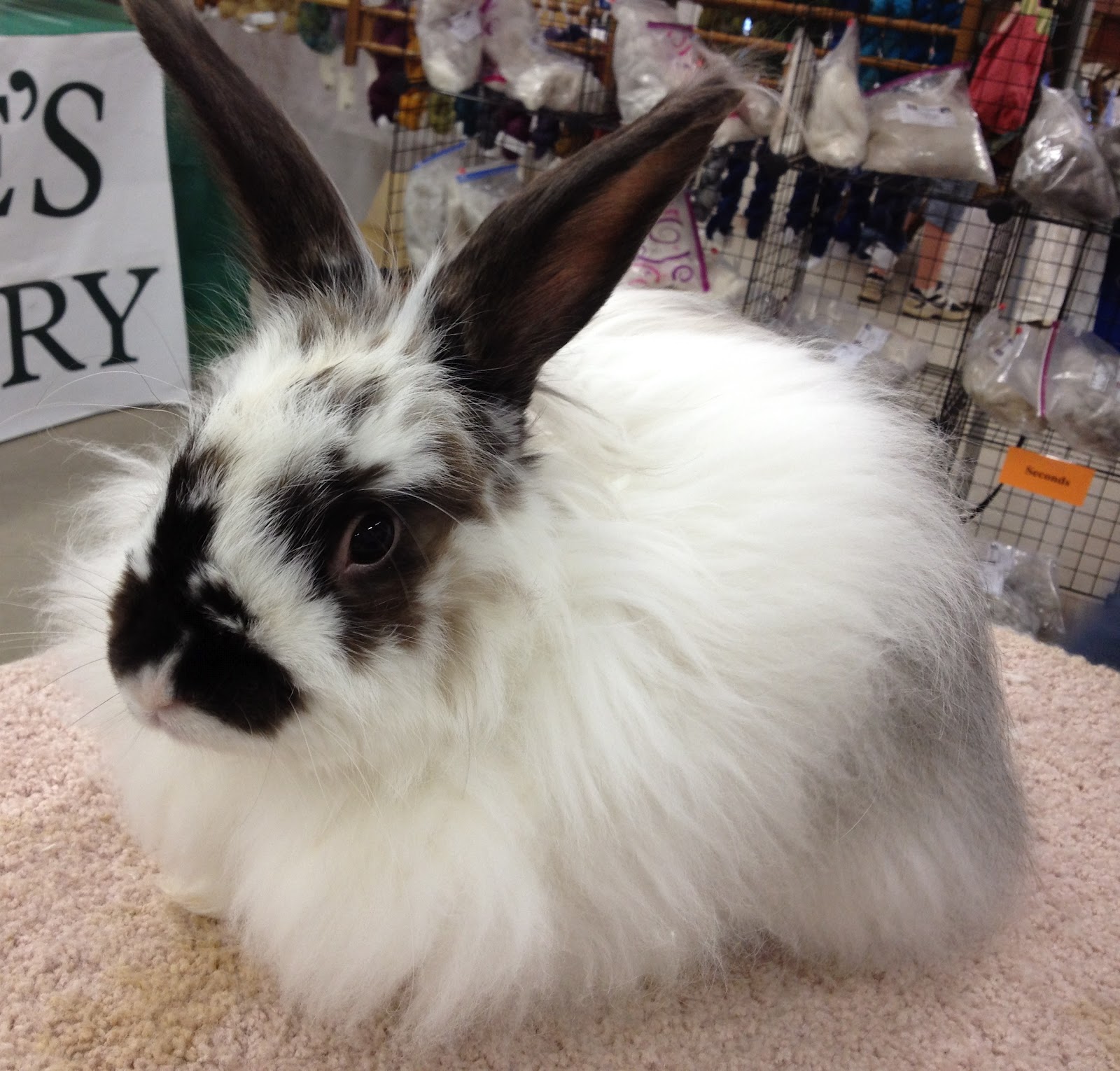
And there were plenty of rabbits at the festival this year. Here is a young cutey:
After enjoying the animals, my friend and I went to the outdoor arena to watch the herding/stock dog demonstrations. Another fun highlight of the festival:
In addition to the animal barns and vendor buildings, the festival has exhibits like the yurt and the historical spinning tent:
After enjoying the animals, the sheep herding, and outdoor exhibits, it was time to find out the skein competition results. I was overjoyed! I won second place in the fine yarn category! My hands were shaking as I touched the ribbon and read the judges' comments on the entry form. It was so exciting!
Still flying high from winning a ribbon, I managed to practice impulse control when walking through all of the vendors. I didn't buy any fiber of any kind during the festival - no fleece, no prepped fiber, no yarn! I was sorely tempted a few times, but I stuck to my stash management goals and exerted some retail purchase self-control. I did bring home a few items, but no new fiber!
I picked out a llama statue from Peru, a small flock of sheep magnets, and a Kundert spindle. Kundert is retiring soon, so I grabbed the opportunity to add one of his beautiful spindles to my collection before they become unavailable. It spins beautifully, so I'm very, very pleased with the purchase. Plus my friend helped me pick out the spindle, so in addition to being an excellent tool, this spindle will be a favorite souvenir of this festival and will always remind me of spending the day with my friend.
On Sunday, I had to drive back to the festival to pick up my yarn and ribbon. Deb Robson and Carol Ekarius, the authors of The Fleece & Fiber Sourcebook, were having a book signing on Sunday afternoon, too. So I ended the festival on a very high note, with getting my copy of the book signed:
I hope everyone who had a chance to attend the festival also had a wonderful experience! I'm already looking forward to next year!
The skein competition has four categories - fine, sport/worsted, bulky, and novelty. I entered my skein into the fine category and was nervous and excited to subject my work to expert opinion. The judges this year were Deb Robson and Shelley Hermanson. Deb Robson, as you may know, is a fiber superstar (former editor of Spin-Off magazine, most recently co-author of The Fleece & Fiber Sourcebook), and Shelley Hermanson is a local fiber expert who has taught countless students all about spinning and knitting. In fact, when I got my first spindle, I arranged to have a private lesson with Shelley at her home. So I was very nervous, in a mostly good way, to have these two women evaluate my spinning.
After dropping off my yarn for the competition, my friend & I wandered over to the animal barns to see the sheep, goats & llamas. It was really lovely to be one of the first festival attendees to go through the barns - no stress, no crowds, no kids (just the goat variety). Seeing all of the fiber critters is really special to me, definitely one of the big highlights of the festival for me. I took pictures of my favorites:
An outgoing, curious Romney ewe:
A sweet and inquisitive Romeldale lamb named Isabelle:
A llama with wicked eye liner:
and I love those long llama eyelashes:
A 12-week old, bottle-fed Horned Dorset ram lamb named Dobbie. Here he is, content and curled over the shepherd's lap. Apparently he gets to wear a diaper and come into the house to watch TV with the family. And he loves playing with the dogs on the farm.
I fell in love. I wanted to take him home with me. Dobbie loves to be stroked and petted - he soaks up all the attention like a little warm wool sponge:
A trio of Jacob ewes... love their horns!
Another trio of fiber females... these ladies are angora goats:
And there were plenty of rabbits at the festival this year. Here is a young cutey:
After enjoying the animals, my friend and I went to the outdoor arena to watch the herding/stock dog demonstrations. Another fun highlight of the festival:
In addition to the animal barns and vendor buildings, the festival has exhibits like the yurt and the historical spinning tent:
Still flying high from winning a ribbon, I managed to practice impulse control when walking through all of the vendors. I didn't buy any fiber of any kind during the festival - no fleece, no prepped fiber, no yarn! I was sorely tempted a few times, but I stuck to my stash management goals and exerted some retail purchase self-control. I did bring home a few items, but no new fiber!
I picked out a llama statue from Peru, a small flock of sheep magnets, and a Kundert spindle. Kundert is retiring soon, so I grabbed the opportunity to add one of his beautiful spindles to my collection before they become unavailable. It spins beautifully, so I'm very, very pleased with the purchase. Plus my friend helped me pick out the spindle, so in addition to being an excellent tool, this spindle will be a favorite souvenir of this festival and will always remind me of spending the day with my friend.
On Sunday, I had to drive back to the festival to pick up my yarn and ribbon. Deb Robson and Carol Ekarius, the authors of The Fleece & Fiber Sourcebook, were having a book signing on Sunday afternoon, too. So I ended the festival on a very high note, with getting my copy of the book signed:
I hope everyone who had a chance to attend the festival also had a wonderful experience! I'm already looking forward to next year!
Friday, May 11, 2012
Making slow progress
I'm making slow (ridiculously slow) progress on my latest yarn, but even slow progress is better than none. I took my six bobbins of spindle-spun singles yarn and loaded them on my ultra premium, high-tech lazy kate (ie. a shoebox with holes poked in the sides). I should've taken a picture of the kate with the full bobbins, but I didn't, so here's the after picture after the yarn has been plied:
And there the bobbins sat for almost two weeks, as I turned my attention to work getting the house ready for a big party last weekend, then cleaning up after the party, and then doing some major spring cleaning work.
So on Wednesday this week, I was irritated enough that I hadn't done any plying that I gave myself an hour to get started on this work. I put the fast whorl on my wheel to fly through the plying as quickly as possible, and I made a good dent on it. I plied about 75% of the singles together in that hour. I decided to make a 3-ply yarn with these singles, after briefly considering a 4-ply yarn. In the end, I chose the 3-ply in order to maximize the yardage I could get out of the original 4 ounce braid of handpainted wool.
This morning I finished the work. Because I was trying to get through my plying as fast as I could, I didn't pay as much attention as usual to using up my bobbins evenly. I ended up with two bobbins that had enough singles left on them that I decided to n-ply the remaining singles at the end of final yarn, which makes me even happier that I had decided to make a 3-ply yarn, since the n-plied section blends in beautifully with the traditional plying.
The plied yarn on the wheel:
Actually, now that I think about it, it's funny that the plying didn't take long at all and yet I still feel like my progress is painfully slow on this yarn. It's probably more accurate to say my progress was severely interrupted and that's what felt so irritating. Now I feel an effervescent relief that the plying is finished, and it will be easy to wind off the yarn, wash it & set the twist, and hang it up to dry. I should be able to finish that work this weekend, and the final yarn will be unveiled next week.
And there the bobbins sat for almost two weeks, as I turned my attention to work getting the house ready for a big party last weekend, then cleaning up after the party, and then doing some major spring cleaning work.
So on Wednesday this week, I was irritated enough that I hadn't done any plying that I gave myself an hour to get started on this work. I put the fast whorl on my wheel to fly through the plying as quickly as possible, and I made a good dent on it. I plied about 75% of the singles together in that hour. I decided to make a 3-ply yarn with these singles, after briefly considering a 4-ply yarn. In the end, I chose the 3-ply in order to maximize the yardage I could get out of the original 4 ounce braid of handpainted wool.
This morning I finished the work. Because I was trying to get through my plying as fast as I could, I didn't pay as much attention as usual to using up my bobbins evenly. I ended up with two bobbins that had enough singles left on them that I decided to n-ply the remaining singles at the end of final yarn, which makes me even happier that I had decided to make a 3-ply yarn, since the n-plied section blends in beautifully with the traditional plying.
The plied yarn on the wheel:
Actually, now that I think about it, it's funny that the plying didn't take long at all and yet I still feel like my progress is painfully slow on this yarn. It's probably more accurate to say my progress was severely interrupted and that's what felt so irritating. Now I feel an effervescent relief that the plying is finished, and it will be easy to wind off the yarn, wash it & set the twist, and hang it up to dry. I should be able to finish that work this weekend, and the final yarn will be unveiled next week.
Monday, April 30, 2012
Spindle project - ready to ply!
I began spinning handpainted BFL wool on a 1 ounce spindle back on February 22nd. I like to have a random, easy spindle project available at all times. On the days when I'm otherwise busy and can't really work on my fiber craft for a long period of time, I can pick up this spindle and spin for a few minutes and still have my "fiber fix" for the day. (Or at least that's the theory - I didn't even do much of this kind of quick spinning in April. I'm really glad today is the last day of this fiber-unfriendly month.)
These easy, ready-to-grab spindle projects are starting to become one of my "default" yarns. I use a semiwoolen drafting method with no particular plans for specific color repeats with the yarn. I spin sections of the wool until the spindle starts to feel heavy, then I wind off the cop to a storage bobbin. I rejoin the remaining single to new fiber and keep spinning until I have enough to fill another bobbin. Then I like to make a final 3-ply yarn from these singles. These random spindle projects tend to produce soft, slightly fuzzy, elastic yarn that are around light fingering to fingering weight, usually 350 - 450 yards from 4 ounces of fiber.
I finishing spinning the singles of this yarn over Easter weekend, and then the rest of April whooshed by me in a blur, so I still haven't plied the singles. Having these singles sitting around is starting to feel a bit like a splinter under my skin - really, really annoying! I want to see how the final yarn turns out! So my spinning project this week is to ply my singles together, which I will do on my wheel.
Here are the six bobbins full of my singles, pictured with the spindle I used for this project:
These easy, ready-to-grab spindle projects are starting to become one of my "default" yarns. I use a semiwoolen drafting method with no particular plans for specific color repeats with the yarn. I spin sections of the wool until the spindle starts to feel heavy, then I wind off the cop to a storage bobbin. I rejoin the remaining single to new fiber and keep spinning until I have enough to fill another bobbin. Then I like to make a final 3-ply yarn from these singles. These random spindle projects tend to produce soft, slightly fuzzy, elastic yarn that are around light fingering to fingering weight, usually 350 - 450 yards from 4 ounces of fiber.
I finishing spinning the singles of this yarn over Easter weekend, and then the rest of April whooshed by me in a blur, so I still haven't plied the singles. Having these singles sitting around is starting to feel a bit like a splinter under my skin - really, really annoying! I want to see how the final yarn turns out! So my spinning project this week is to ply my singles together, which I will do on my wheel.
Here are the six bobbins full of my singles, pictured with the spindle I used for this project:
Wednesday, April 25, 2012
Um, can't you just buy yarn from a store?
I was recently asked this question: "Um, can't you just buy yarn from a store?"
The short answer? No, you absolutely cannot buy this yarn from a store, unless I opened one. This yarn is a handmade gem and represents skill, craft, and even a little bit of love.
The long answer? Keep reading.
Yes, of course you can buy yarn from a store. And I do buy yarn from stores. I can get national brand, workhorse kinds of yarn from big box stores (JoAnn's, Michaels, etc.), and I can get specialty and luxury yarns from local yarn shops and several online stores. In fact, I have a particular weakness for Koigu yarns and sock yarns.
So it seems to me that the real question is, why do you spin yarn in this modern age?
I don't resent this question. The first time I heard of someone spinning her own yarn, I thought it was a little nutty. "Hm, that's odd. It's an interesting idea, but isn't that kinda like wasting time better spent on knitting when you can just buy yarn?" I didn't get it.
Out of all handcrafts and handmade pursuits, from woodworking to knitting to canning your own pickles, spinning seems to stand out in the public eye as a particularly strange, unfamiliar choice. The irony is that for thousands of years in all cultures, and still today in a few places in the world, spinning yarn was a daily household chore. But in the industrialized Western world, spinning yarn is so unnecessary for daily life that it is now extremely old-fashioned, really bordering on archaic, and is therefore a little bit bizarre. I've thought about this a lot, and my theory is that spinning appears to be an odd choice because it doesn't have a final product that is ready to use in & of itself. A woodworker creates a piece of furniture, a knitter creates a sweater, and the pickles are very tasty -- and all of these kind of handmade items are immediately functional. But yarn is an intermediary step to the final product, such as the sweater, and therefore from an outside point of view, spinning would appear a very inefficient use of one's time.
The general unfamiliarity of spinning is actually a very good thing. I know that I would not want to have the burden of spinning all the yarn that was necessary for my family's life or income. Leaving the bulk of textile manufacture to the big mills suits me just fine. It allows spinning to become a deliberate choice, a form of craft and self-expression.
But I still haven't answered the question, why spin? why make this choice?
Spinning just clicked with me on some fundamental level. Once I picked up a spindle and gained a tiny bit of competence with it (it didn't take much!), I thought, "Whoa, this is awesome. This is fun, this feels good, this is interesting, this is unique!"
I love to knit, to crochet, to play with paper & ink, but spinning has become my favorite craft. I experience joy and quiet satisfaction in the competence of my hands while making yarn. I love preparing fiber for spinning. I love the feel of the fiber moving through my fingers. Spinning is a very rhythmic and repetitive craft, and once I'm in the zone so to speak, there is a meditative quality to the work. My hands know what to do, and my mind is able to wander, but not aimlessly. I do some of my best thinking while I spin.
I was so utterly wrong to first think of spinning as a waste or inefficient use of time. There is actually a gift of time with spinning. When I grab a spindle or sit in front of my wheel and spin, I am giving that time to myself. I'm giving myself the space to sit, breathe, think, and feel good.
So, my final answer to the question is, yes, I can buy yarn from a store. But no, I can't buy this yarn from a store, and this yarn represents an investment in a good life.
The short answer? No, you absolutely cannot buy this yarn from a store, unless I opened one. This yarn is a handmade gem and represents skill, craft, and even a little bit of love.
The long answer? Keep reading.
Yes, of course you can buy yarn from a store. And I do buy yarn from stores. I can get national brand, workhorse kinds of yarn from big box stores (JoAnn's, Michaels, etc.), and I can get specialty and luxury yarns from local yarn shops and several online stores. In fact, I have a particular weakness for Koigu yarns and sock yarns.
So it seems to me that the real question is, why do you spin yarn in this modern age?
I don't resent this question. The first time I heard of someone spinning her own yarn, I thought it was a little nutty. "Hm, that's odd. It's an interesting idea, but isn't that kinda like wasting time better spent on knitting when you can just buy yarn?" I didn't get it.
Out of all handcrafts and handmade pursuits, from woodworking to knitting to canning your own pickles, spinning seems to stand out in the public eye as a particularly strange, unfamiliar choice. The irony is that for thousands of years in all cultures, and still today in a few places in the world, spinning yarn was a daily household chore. But in the industrialized Western world, spinning yarn is so unnecessary for daily life that it is now extremely old-fashioned, really bordering on archaic, and is therefore a little bit bizarre. I've thought about this a lot, and my theory is that spinning appears to be an odd choice because it doesn't have a final product that is ready to use in & of itself. A woodworker creates a piece of furniture, a knitter creates a sweater, and the pickles are very tasty -- and all of these kind of handmade items are immediately functional. But yarn is an intermediary step to the final product, such as the sweater, and therefore from an outside point of view, spinning would appear a very inefficient use of one's time.
The general unfamiliarity of spinning is actually a very good thing. I know that I would not want to have the burden of spinning all the yarn that was necessary for my family's life or income. Leaving the bulk of textile manufacture to the big mills suits me just fine. It allows spinning to become a deliberate choice, a form of craft and self-expression.
But I still haven't answered the question, why spin? why make this choice?
Spinning just clicked with me on some fundamental level. Once I picked up a spindle and gained a tiny bit of competence with it (it didn't take much!), I thought, "Whoa, this is awesome. This is fun, this feels good, this is interesting, this is unique!"
I love to knit, to crochet, to play with paper & ink, but spinning has become my favorite craft. I experience joy and quiet satisfaction in the competence of my hands while making yarn. I love preparing fiber for spinning. I love the feel of the fiber moving through my fingers. Spinning is a very rhythmic and repetitive craft, and once I'm in the zone so to speak, there is a meditative quality to the work. My hands know what to do, and my mind is able to wander, but not aimlessly. I do some of my best thinking while I spin.
I was so utterly wrong to first think of spinning as a waste or inefficient use of time. There is actually a gift of time with spinning. When I grab a spindle or sit in front of my wheel and spin, I am giving that time to myself. I'm giving myself the space to sit, breathe, think, and feel good.
So, my final answer to the question is, yes, I can buy yarn from a store. But no, I can't buy this yarn from a store, and this yarn represents an investment in a good life.
Monday, April 23, 2012
Finished Femme Fatale yarn
Aaaaaahhh!! Where did April go? I can't believe it's April 23rd. The month started out with a trip to Indiana and only built from there. It's been a really busy month and all of my blogging habits bit the dust. Actually, my fiber craft in general bit the dust, and it's time to get back on track with it. This probably explains my recent irritability - I must be in severe wool withdrawal.
I did manage to finish my Femme Fatale yarn by the end of March, just in the nick of time for the Spindlers monthly challenge. So I will reconnect with my blog by publishing the details of this yarn.
I'm really happy with this yarn! It is the finest and most consistent yarn I've produced to date, and I have decided to submit it to the upcoming Shepherd's Harvest skein competition. There are a lot of excellent spinners in this region, so I don't expect to win anything, but it will be a lot of fun to add my yarn to the competition. It means I've reached an important milestone for my fiber craft - I feel confident enough about my skills in order to submit my work for judgement.
To refresh everyone's memory, the Spindlers group in Ravelry has a monthly challenge, where a theme is announced and whoever wants to participate must start & finish a spindle-spun yarn within that calendar month. March's theme was Femme Fatale, which was very fun to interpret in yarn. (Here is my announcement of this yarn project, and the update in the middle of the project.)
I created a seductive laceweight yarn in jewel tones, using handpainted BFL wool & tussah silk blend fiber. My plan was to spin a very fine yarn with lots of drape and as much luster as possible. Using a one ounce cherry wood spindle and worsted drafting, I started spinning very fine singles. I was very careful with my drafting, making sure that I evenly drafted out the wool & silk together. It's easy to draft the longer silk fibers out of the blend, leaving the wool behind in your fiber hand, and I wanted to avoid that problem. The singles averaged 70 WPI:
I spun two singles, which I then plied together to create the final 2-ply yarn. Since this is a worsted yarn, I finished the yarn very simply, just to set the twist and not to full the yarn in any way. I soaked the skein in hot water for several minutes, changing the water a couple of times, but that's about it. I pressed out the water, snapped the yarn over my wrists a few times, then hung the yarn to dry without any weight on the skein.
The finished yarn is beautifully balanced, with no overspun or overplied areas. It has a lovely drape, not much elasticity, and a really pretty shimmer from the silk that is evenly blended throughout the yarn. Mission accomplished! Eventually, this yarn will become a scarf or shawl. I'm researching patterns for it and haven't quite made up my mind yet. Any pattern recommendations are welcome!
The final yarn:
BFL wool & tussah silk blend
2-ply, worsted drafting
2.5 ounces (70 grams), 42 WPI (laceweight), 500 yards
I did manage to finish my Femme Fatale yarn by the end of March, just in the nick of time for the Spindlers monthly challenge. So I will reconnect with my blog by publishing the details of this yarn.
I'm really happy with this yarn! It is the finest and most consistent yarn I've produced to date, and I have decided to submit it to the upcoming Shepherd's Harvest skein competition. There are a lot of excellent spinners in this region, so I don't expect to win anything, but it will be a lot of fun to add my yarn to the competition. It means I've reached an important milestone for my fiber craft - I feel confident enough about my skills in order to submit my work for judgement.
To refresh everyone's memory, the Spindlers group in Ravelry has a monthly challenge, where a theme is announced and whoever wants to participate must start & finish a spindle-spun yarn within that calendar month. March's theme was Femme Fatale, which was very fun to interpret in yarn. (Here is my announcement of this yarn project, and the update in the middle of the project.)
I created a seductive laceweight yarn in jewel tones, using handpainted BFL wool & tussah silk blend fiber. My plan was to spin a very fine yarn with lots of drape and as much luster as possible. Using a one ounce cherry wood spindle and worsted drafting, I started spinning very fine singles. I was very careful with my drafting, making sure that I evenly drafted out the wool & silk together. It's easy to draft the longer silk fibers out of the blend, leaving the wool behind in your fiber hand, and I wanted to avoid that problem. The singles averaged 70 WPI:
I spun two singles, which I then plied together to create the final 2-ply yarn. Since this is a worsted yarn, I finished the yarn very simply, just to set the twist and not to full the yarn in any way. I soaked the skein in hot water for several minutes, changing the water a couple of times, but that's about it. I pressed out the water, snapped the yarn over my wrists a few times, then hung the yarn to dry without any weight on the skein.
The finished yarn is beautifully balanced, with no overspun or overplied areas. It has a lovely drape, not much elasticity, and a really pretty shimmer from the silk that is evenly blended throughout the yarn. Mission accomplished! Eventually, this yarn will become a scarf or shawl. I'm researching patterns for it and haven't quite made up my mind yet. Any pattern recommendations are welcome!
The final yarn:
BFL wool & tussah silk blend
2-ply, worsted drafting
2.5 ounces (70 grams), 42 WPI (laceweight), 500 yards
Subscribe to:
Posts (Atom)


