In honor of St. Patrick's day, I am finally finishing the "mixed greens" yarn that has been a WIP (work-in-progress) for months. You might recall that I spun the singles (all of them spun on spindles) and wound them on to storage bobbins back in October. Now that I have rediscovered my wheel, it's time to ply these singles together so that I can gaze affectionately upon my finished green yarn. And there is an added boost of satisfaction since I dyed this yarn myself.
After staring at the bobbins for a few minutes and having a fierce internal debate about my plying choices (Navajo? 2-ply? 3-ply? did I even want to contemplate a 4-ply?), I decided to create a 3-ply yarn where I would randomly drop & add strands from the different bobbins to create subtle color transitions in the final yarn.
Plying the singles together on my wheel:
The bobbin full of the plied yarn and the bits of singles left over:
Ta-dah! The finished St. Patrick's Day yarn! And what I have learned from this yarn? I have learned that while I love to spin singles on spindles, I prefer my wheel over spindles for plying. I also thought it was very cool to see how the greens blended optically in this yarn - from a distance, the yarn is a beautiful grass green color, while its components are a mossy green and emerald green.
Vital statistics: Coopworth & Blue-faced Leicester wools, 256 yards, 2.4 ounces, 20 wpi, laceweight
Thursday, March 17, 2011
Wednesday, March 16, 2011
Wooly Word of the Week: Carding
The new tradition continues! Last Wednesday I posted my first Wooly Word(s) of the Week, and they have now been moved to the new Glossary page located on the blog's sidebar.
As I continue to prepare Pixie Girl's fleece for spinning, I know that I will be spending plenty of time carding wool. It seemed appropriate to make this process the week's wooly words.
Carding: a method of preparing fibers using carding cloth that separates fibers from each other and aligns them randomly. Carding does not eliminate fibers, but blends all fibers together that are introduced to the carding cloth. The results of carding are rolags (using handcards), batts (drum carder), or roving (batts that have been made into strips).
Carding cloth: Carding cloth is a grid of small wire teeth set into a background material such as leather or rubber. The density of the wire teeth per square inch determines the kind of fibers that can be carded on it. For example, cotton carders typically have 250 or more teeth per square inch, while general purpose handcards can range from 75 - 120 teeth per square inch.
Rolag: a cylinder of carded fiber produced by using handcards
Batt: a rectangle of carded fiber produced by using a drum carder
Roving: a strip of carded fiber
Pros of carding: Carding is an excellent method of blending fibers together. This can mean everything from homogenizing a single fleece to creating blends of different kinds of fibers (ie. wool and silk) to creating color blends of fibers. Carding is also the method used to prepare fibers for woolen spinning. Carding is especially well-suited for preparing short fibers, such as cotton, animal downs (ie. cashmere), and shorter wools with springy crimp.
Cons of carding: Carding does not eliminate any kind of fiber, which means that anything included in the original fiber will show up in the end result. You will not be getting rid of any weaker, tender fibers or any neps/noils when using carding as your preparation. Carding is also not intended as a method of getting rid of grit or vegetable matter in the fiber. Carding very long fibers can be tricky and is usually best done on a drum carder, rather than handcards.
Tools of carding: For the handspinner, the two primary methods of carding are using handcards or a drum carder. Commercial mills more or less use giant, motorized drum carders to create extra-large batts, which can be left as is or divided into strips of roving.
In case you haven't seen them before, here are photos of handcards & a drum carder. I have chosen to show photos of tools that I own, which I suppose is an endorsement of these particular products, but there are certainly several excellent tools made by other companies, too:
Schacht curved handcards (112 teeth/inch):
Strauch "Finest" drum carder:
As I continue to prepare Pixie Girl's fleece for spinning, I know that I will be spending plenty of time carding wool. It seemed appropriate to make this process the week's wooly words.
Carding: a method of preparing fibers using carding cloth that separates fibers from each other and aligns them randomly. Carding does not eliminate fibers, but blends all fibers together that are introduced to the carding cloth. The results of carding are rolags (using handcards), batts (drum carder), or roving (batts that have been made into strips).
Carding cloth: Carding cloth is a grid of small wire teeth set into a background material such as leather or rubber. The density of the wire teeth per square inch determines the kind of fibers that can be carded on it. For example, cotton carders typically have 250 or more teeth per square inch, while general purpose handcards can range from 75 - 120 teeth per square inch.
Rolag: a cylinder of carded fiber produced by using handcards
Batt: a rectangle of carded fiber produced by using a drum carder
Roving: a strip of carded fiber
Pros of carding: Carding is an excellent method of blending fibers together. This can mean everything from homogenizing a single fleece to creating blends of different kinds of fibers (ie. wool and silk) to creating color blends of fibers. Carding is also the method used to prepare fibers for woolen spinning. Carding is especially well-suited for preparing short fibers, such as cotton, animal downs (ie. cashmere), and shorter wools with springy crimp.
Cons of carding: Carding does not eliminate any kind of fiber, which means that anything included in the original fiber will show up in the end result. You will not be getting rid of any weaker, tender fibers or any neps/noils when using carding as your preparation. Carding is also not intended as a method of getting rid of grit or vegetable matter in the fiber. Carding very long fibers can be tricky and is usually best done on a drum carder, rather than handcards.
Tools of carding: For the handspinner, the two primary methods of carding are using handcards or a drum carder. Commercial mills more or less use giant, motorized drum carders to create extra-large batts, which can be left as is or divided into strips of roving.
In case you haven't seen them before, here are photos of handcards & a drum carder. I have chosen to show photos of tools that I own, which I suppose is an endorsement of these particular products, but there are certainly several excellent tools made by other companies, too:
Schacht curved handcards (112 teeth/inch):
Strauch "Finest" drum carder:
Tuesday, March 15, 2011
Rediscovering the wheel
Since last spring, all of my spinning has been done on spindles. I love them - I can keep a spindle & some fiber in my bag and enjoy spinning whenever and wherever I want. But I also have a gorgeous wheel that has been ridiculously neglected and it's time to rediscover it. I know that I want to use my wheel to spin Pixie Girl's fleece, so I'm trying to think ahead and get the wheel ready for this project.
The last spinning I did on my wheel was with 12 ounces of dark mill ends (I don't know if the fiber color is natural or dyed). I have four bobbins of these mill end singles and it's long overdue to ply them and finish the yarn. And I need the bobbins for my next project!
The singles have been on bobbins long enough that the twist has gone dormant. I refreshed sample strands of the yarn in hot water to determine what a balanced 3-ply yarn would look like using these singles. I learned this technique on Rita Buchanan's DVD "How I Spin." Rita is fabulous, using a common sense & analytical approach to spinning yarn without losing the art of it by over-focusing on calculations. The refreshed sample serves as your template that you can use throughout the plying process to make sure that you're staying on target to create a balanced yarn.
I got to work plying the singles, and because the plying twist is the active energy in the skein, the yarn was very curly and kinked up on itself when it came off the wheel. At the beginning of my spinning days, I would've been dismayed and convinced that I had messed up. Now I understand a bit more about the twist energy in yarn and I was actually happy to see the curly plied yarn.
I had enough singles on my bobbins to get three skeins of 3-ply yarn, and still had enough singles left on two of the bobbins that I thought, eh, what the heck, let's finish those with a 2-ply yarn. Now it's off to finish the yarn in hot water, give it a few good thwacks & hang it up to dry.
The last spinning I did on my wheel was with 12 ounces of dark mill ends (I don't know if the fiber color is natural or dyed). I have four bobbins of these mill end singles and it's long overdue to ply them and finish the yarn. And I need the bobbins for my next project!
The singles have been on bobbins long enough that the twist has gone dormant. I refreshed sample strands of the yarn in hot water to determine what a balanced 3-ply yarn would look like using these singles. I learned this technique on Rita Buchanan's DVD "How I Spin." Rita is fabulous, using a common sense & analytical approach to spinning yarn without losing the art of it by over-focusing on calculations. The refreshed sample serves as your template that you can use throughout the plying process to make sure that you're staying on target to create a balanced yarn.
I got to work plying the singles, and because the plying twist is the active energy in the skein, the yarn was very curly and kinked up on itself when it came off the wheel. At the beginning of my spinning days, I would've been dismayed and convinced that I had messed up. Now I understand a bit more about the twist energy in yarn and I was actually happy to see the curly plied yarn.
I had enough singles on my bobbins to get three skeins of 3-ply yarn, and still had enough singles left on two of the bobbins that I thought, eh, what the heck, let's finish those with a 2-ply yarn. Now it's off to finish the yarn in hot water, give it a few good thwacks & hang it up to dry.
Monday, March 14, 2011
Continuing with Pixie Girl's fleece
Before carding wool, the fiber is "picked," meaning the individual locks of wool are picked apart so that they can be easily spread across the teeth of carding cloth. The process is also supposed to help get rid of any grit or vegetable matter (seeds, bits of grass, etc.) in the wool. Picking wool can be done by hand or by picking tools. There are a few basic designs of pickers, but since I do not have one, this is a job I do by hand.
In the case of Pixie Girl's fleece, picking by hand was also necessary even if I had a picker tool. Even though the washing & rinsing process got rid of a lot of grit that was in the fleece, there was still plenty left that needed to be removed before spinning and I don't think a picker would be nearly as thorough as my hands for this particular fleece. There were also some short cuts in the wool (short cuts are an undesirable error in shearing) that I needed to remove before spinning. I initially tried just picking open the locks by hand, but quickly found out that I needed a bit of help with a flicker or small comb.
After experimenting with different tools, I came up with a process that works extremely well for this fleece: (1) use a metal dog grooming comb to open both ends of the locks, which removes any short cuts or neps, plus helps get rid of any big pieces of vegetable matter, then (2) finish picking the lock by hand, which removes almost all remaining grit plus opens the lock completely to prepare for carding the wool. I am pretty vigorous with how I use the dog comb on the fleece - if there are any tender (thin or breakable) fibers in the lock, I want the comb to pull them out, so that I'm left with the best possible parts of the fleece for carding. This combing step produces more waste than simply picking by hand did, but I noticed a serious improvement in my picked wool, so I think the extra time and increased waste is well worth it.
Granted, this handpicking process could be a very tedious & boring chore, but I actually find it relaxing and meditative. I tend to pick a handful of the clean wool each morning while I listen to Minnesota Public Radio and sip my morning coffee. I keep this task easily available in my living room, where I usually spend my mornings. I have a basket of the clean wool, a piece of leather I put over my lap where any of grit and stuff can land as I pick the wool, another basket for the picked wool, and a small basket for the waste wool from the combing. I can keep the whole works stored neatly under the coffee table - the baskets look pretty and it keeps the materials easily available to me whenever I want to spend a few minutes on it. This photo shows the baskets of clean wool & picked wool and line-up of unpicked wool lock, combed lock, and picked lock on top of the leather:
The picked wool is wonderful to touch - it is a soft cloud of fiber that will card beautifully. Here is a picture of me holding about 4 grams of picked wool - just 4 grams and look how puffy and soft it is!
In the case of Pixie Girl's fleece, picking by hand was also necessary even if I had a picker tool. Even though the washing & rinsing process got rid of a lot of grit that was in the fleece, there was still plenty left that needed to be removed before spinning and I don't think a picker would be nearly as thorough as my hands for this particular fleece. There were also some short cuts in the wool (short cuts are an undesirable error in shearing) that I needed to remove before spinning. I initially tried just picking open the locks by hand, but quickly found out that I needed a bit of help with a flicker or small comb.
After experimenting with different tools, I came up with a process that works extremely well for this fleece: (1) use a metal dog grooming comb to open both ends of the locks, which removes any short cuts or neps, plus helps get rid of any big pieces of vegetable matter, then (2) finish picking the lock by hand, which removes almost all remaining grit plus opens the lock completely to prepare for carding the wool. I am pretty vigorous with how I use the dog comb on the fleece - if there are any tender (thin or breakable) fibers in the lock, I want the comb to pull them out, so that I'm left with the best possible parts of the fleece for carding. This combing step produces more waste than simply picking by hand did, but I noticed a serious improvement in my picked wool, so I think the extra time and increased waste is well worth it.
Granted, this handpicking process could be a very tedious & boring chore, but I actually find it relaxing and meditative. I tend to pick a handful of the clean wool each morning while I listen to Minnesota Public Radio and sip my morning coffee. I keep this task easily available in my living room, where I usually spend my mornings. I have a basket of the clean wool, a piece of leather I put over my lap where any of grit and stuff can land as I pick the wool, another basket for the picked wool, and a small basket for the waste wool from the combing. I can keep the whole works stored neatly under the coffee table - the baskets look pretty and it keeps the materials easily available to me whenever I want to spend a few minutes on it. This photo shows the baskets of clean wool & picked wool and line-up of unpicked wool lock, combed lock, and picked lock on top of the leather:
The picked wool is wonderful to touch - it is a soft cloud of fiber that will card beautifully. Here is a picture of me holding about 4 grams of picked wool - just 4 grams and look how puffy and soft it is!
Friday, March 11, 2011
Like manna from heaven
I joyfully received shipments from woolgatherings this week. They are my favorite shop for handpainted fibers, and I indulged myself with my latest order and also purchased their luxury fiber sampler.
Here is my loot:
The luxury fiber sampler contains ten gorgeous types of fibers & blends. I know that I won't do much more than admire and pet these fibers for a while, giving myself plenty of time to dream about what I can make with them.
1 oz - 50% Baby Camel / 50% Tussah Silk
1 oz - Milk Fiber
1 oz - 80% Merino / 20% Cashmere
1 oz - 80% Merino / 20% Angora
1 oz - 50% Merino / 50% Cultivated Silk
1 oz - 50% Merino / 50% Yak
1 oz - Fine Alpaca
Here is my loot:
love, love, LOVE this handpainted 50% Merino, 50% silk fiber, which was the March 2011 Fiber Club's special edition:
And when I saw this fiber, it reminded me of Rainier cherries and I had to have it. It is 100% Blue-faced Leicester fiber:
The luxury fiber sampler contains ten gorgeous types of fibers & blends. I know that I won't do much more than admire and pet these fibers for a while, giving myself plenty of time to dream about what I can make with them.
1 oz - 50% Baby Camel / 50% Tussah Silk
1 oz - Milk Fiber
1 oz - 50% Alpaca / 30% Merino / 20% Tussah Silk
1 oz - 75% BFL / 25% Tussah Silk
1 oz - 50% Merino / 30% Cultivated Silk / 20% Angora1 oz - 80% Merino / 20% Cashmere
1 oz - 80% Merino / 20% Angora
1 oz - 50% Merino / 50% Cultivated Silk
1 oz - 50% Merino / 50% Yak
1 oz - Fine Alpaca
Wednesday, March 9, 2011
Wooly Words of the Week: Corriedale, Shetland & Rambouillet
For some time now, I have wanted to create a glossary page in my blog. It occured to me that the best way to chip away at a big glossary project is to have weekly additions to it. Therefore, I am unveiling a new zeithound blog tradition. Each Wednesday, I will post a wooly word (or words) of the week which will likely be related to whatever spinning or knitting work that I've been doing recently. The following Wednesday, when new wooly words of the week are posted, the previous week's words will move to the official glossary page that will be located on the sidebar of my blog.
For this week, in honor of yesterday's post about Pixie Girl's fleece and her genetic heritage, the wooly words of the week will be her mix of sheep breeds:
Corriedale: This sheep breed was developed in New Zealand in the 1860's from crossing British longwool rams with Merino ewes, with the goal to have a dual purpose sheep that adapted well to different environments and produced high quality meat and wool. The Corrie has been a very successful breed and is now the second most populous sheep in the world after the Merino. Corriedale wool is considered a fine wool, but has some luster from its longwool heritage. It is generally soft with a very well-defined crimp. Much like the adaptable nature of the sheep, its wool can be prepared and spun in a variety of methods and is a favorite of many handspinners.
Shetland: Shetland sheep are part of the Northern European Short-Tailed group of sheep, making them cousins of Icelandic and Finn sheep. They come from the Shetland Islands located northeast of Scotland, where their geographic isolation helped keep them very closely related to their original stock that was likely left on the islands by Vikings about 1,000 years ago. Their primitive ancestory gives their fleece characteristics such as a dual coat with a tendency to molt, and a large variety of natural colors. Shetland fleeces can contain several different fiber types in a single fleece, with the finest wool located around the neck. The wool has a well-defined crimp that almost spirals, and can be extremely soft and bouncy. Shetland wool is excellent to spin woolen and has a tendency to bloom (or spread out) in yarn, creating a very airy, lofty, and soft yarn.
Rambouillet: The Rambouillet breed began with a gift of highly coveted Spanish Merino sheep to King Louis XVI in 1786. While the French Revolution wasn't kind to Louis, the royal sheep thrived and eventually became the base stock for most sheep breeding in the western United States. They are the largest sheep of all fine wool breeds, and are primarily bred for their wool, not for their meat. Their fleece is very soft with a defined crimp that can be a bit disorganized, and this kind of springy crimp lends itself very nicely to yarns that are soft, elastic and lofty. Rambouillet wool has a very high quantity of lanolin and felts together extremely well.
For this week, in honor of yesterday's post about Pixie Girl's fleece and her genetic heritage, the wooly words of the week will be her mix of sheep breeds:
Corriedale: This sheep breed was developed in New Zealand in the 1860's from crossing British longwool rams with Merino ewes, with the goal to have a dual purpose sheep that adapted well to different environments and produced high quality meat and wool. The Corrie has been a very successful breed and is now the second most populous sheep in the world after the Merino. Corriedale wool is considered a fine wool, but has some luster from its longwool heritage. It is generally soft with a very well-defined crimp. Much like the adaptable nature of the sheep, its wool can be prepared and spun in a variety of methods and is a favorite of many handspinners.
Shetland: Shetland sheep are part of the Northern European Short-Tailed group of sheep, making them cousins of Icelandic and Finn sheep. They come from the Shetland Islands located northeast of Scotland, where their geographic isolation helped keep them very closely related to their original stock that was likely left on the islands by Vikings about 1,000 years ago. Their primitive ancestory gives their fleece characteristics such as a dual coat with a tendency to molt, and a large variety of natural colors. Shetland fleeces can contain several different fiber types in a single fleece, with the finest wool located around the neck. The wool has a well-defined crimp that almost spirals, and can be extremely soft and bouncy. Shetland wool is excellent to spin woolen and has a tendency to bloom (or spread out) in yarn, creating a very airy, lofty, and soft yarn.
Rambouillet: The Rambouillet breed began with a gift of highly coveted Spanish Merino sheep to King Louis XVI in 1786. While the French Revolution wasn't kind to Louis, the royal sheep thrived and eventually became the base stock for most sheep breeding in the western United States. They are the largest sheep of all fine wool breeds, and are primarily bred for their wool, not for their meat. Their fleece is very soft with a defined crimp that can be a bit disorganized, and this kind of springy crimp lends itself very nicely to yarns that are soft, elastic and lofty. Rambouillet wool has a very high quantity of lanolin and felts together extremely well.
Tuesday, March 8, 2011
Meet Pixie Girl and her 2010 fleece
The wool had been cold soaked by the shepherd, so it arrived to me free of mud and other cakey barnyard materials (you know what I'm talking about, right?), but it had plenty of grit and vegetal matter in it, and still had all of its original lanolin. I tried a new method to wash her fleece, using a bathtub in order to wash all of it at once without having to sort out individual staples of wool. I bought a few yards of tulle from Joann Fabric and used that to line the bathtub. I filled the tub with extremely hot water and added simple detergent to the water (Fleet Farm show paste, which is the same thing as Orvus paste), not agitating it very much because I didn't want lots of soap suds in the water. I dumped the fleece into the water and let it soak for 20 minutes, then used the tulle to pull it out of the water, hooking the ends of the tulle over a towel rod in the tub to let the water drain from the wool. The wool still felt a little too sticky, so I knew there was still more lanolin in it than I wanted. I emptied the tub and refilled with with fresh hot water & soap to soak the wool one more time. Two washes seemed to take most of stickiness out of the wool. I decided it was ready to rinse, and I used the same process with fresh hot water (and no soap, obviously) until any residual soap seemed to be gone. Each wash & rinse cycle got rid of an amazing amount of grit in the fleece. I spread the wet wool on a couple of sweater racks and let them dry. The cleaned wool:
Pixie Girl's heritage of Corriedale-Shetland-Rambouillet gives her fleece some interesting characteristics. There was definitely a lot of lanolin in the raw fleece, more than I would expect in a primarily Corriedale fleece, so I assume that the Rambouillet (which is basically French merino sheep) contributed to the quantity of lanolin in the fleece. I got most of it out in the washing process, but I wasn't fanatical about it. The clean fleece has a trace of lanolin, which I like in this instance. The wool is actually very soft, which I tested by touching a bundle of the clean wool against my neck to see how scratchy it felt. There was no irritation against my skin, and I'm pretty sensitive to any kind of scratchiness against my skin.
Pixie Girl's mixed heritage has also given her fleece some very different staples (or locks) of wool. The staples range from about 2 to 3 inches, some of which have a more pronounced crimp that definitely seems more Corriedale to me (see the middle staple in the picture below), while some staples have a much finer, almost spiraling, crimp that would seem to come from the Shetland-Rambouillet portion of her genetics. The wool has a lot of bounce to it - a lot of natural springiness. Here are some very typical examples of the kinds of staples that I have gotten out of this fleece:
Because this wool has lots of different staple sizes and characteristics, plus it is very soft and bouncy, I have decided to continue processing this wool in a carded preparation for woolen spinning. This process will blend the fleece together, and the spinning style will create a very lightweight, lofty, bouncy yarn that will be perfect for hats or sweaters, or any other garment that would benefit from a very warm, insulating yarn that is lightweight. It wouldn't be as successful for something like socks, because woolen yarn isn't as durable against abrasion as a yarn that is spun in more of a worsted style.
Friday, March 4, 2011
You know you got it bad when...
...you notice that the swiffer duster refill has an interesting crimp structure. The outside white part is reminiscent of English long wools with a more open crimp, while the blue inner fibers are very Merino-like with a fine, tighter crimp.
I've been spending a lot of time lately learning about wool structure and working with raw fleece, and I think it's showing when I dissect a cleaning tool because it reminds me of wool and I consider what it might be like to spin the blue swiffer fibers just to see what happens.
Saturday, February 5, 2011
Building a new "normal"
For the past few months leading up to January 2011, life kept getting crazier and more stressful. I was notified that my position was being eliminated at the corporation where I worked, my husband suffered from terrible pain in his neck, my mother-in-law was extremely ill with a chronic and terminal disease, and the holiday season was just around the corner. December was particularly stressful, with my husband having major surgery on his cervical spine, his mother starting home hospice care, and me trying to get all of my necessary tasks done for Christmas. And then January rolled around and made December seem not quite so difficult. In January, my job officially ended, my husband still had more post-surgical pain that we had expected, and my mother-in-law passed away last week. I'm left feeling like I was (poorly) juggling too many balls in the air, frequently dropping several at a time, then trying to pick them back up and find a good rhythm to keep everything moving simultaneously, when all of a sudden some maniac comes along and completely knocks all the balls away from me at once.
So here I am, looking at all these balls scattered around me. I know that nothing is ever going to be the same as it was. The coming year is going to be bittersweet as my husband, his sisters, his grandfather, me and other family & friends have their first year of birthdays, holidays, events & just plain every day life without his mother. I don't have the familiar stability of a job I know how to do inside-out, even though it could be a very frustrating work environment and I wasn't always happy there. What was once "normal" is now gone forever and I am facing the task of creating a new "normal" for myself. I do have a strong optimist streak in me, so I'm trying to see these so-called balls laying around me as an opportunity to be very choosy about which ones I will pick up again for this new "normal" that I must create. I'm trying to focus on self-care items, so that I can be at my best in order to take care of those I love and find new work that will satisfy me and use my skills & talents.
Needless to say, taking care of myself includes spending time with my fiber art. I can confidently state that knitting and spinning time during these past few months has been key in maintaining my sanity.
So here I am, looking at all these balls scattered around me. I know that nothing is ever going to be the same as it was. The coming year is going to be bittersweet as my husband, his sisters, his grandfather, me and other family & friends have their first year of birthdays, holidays, events & just plain every day life without his mother. I don't have the familiar stability of a job I know how to do inside-out, even though it could be a very frustrating work environment and I wasn't always happy there. What was once "normal" is now gone forever and I am facing the task of creating a new "normal" for myself. I do have a strong optimist streak in me, so I'm trying to see these so-called balls laying around me as an opportunity to be very choosy about which ones I will pick up again for this new "normal" that I must create. I'm trying to focus on self-care items, so that I can be at my best in order to take care of those I love and find new work that will satisfy me and use my skills & talents.
Needless to say, taking care of myself includes spending time with my fiber art. I can confidently state that knitting and spinning time during these past few months has been key in maintaining my sanity.
Friday, January 14, 2011
Knitting Lessons, part 1
This past Sunday, I had a delightful afternoon of teaching knitting to my oldest friend, my best friend from high school in fact. She had a bit of experience already, but had not knit for several years. And folks, she's a natural - beautifully even stitches and a relaxed attitude. It made teaching fun and gave me some food for thought. I really enjoy teaching knitting and other fiber arts and I need to think about finding more official ways of sharing my love of this craft with others.
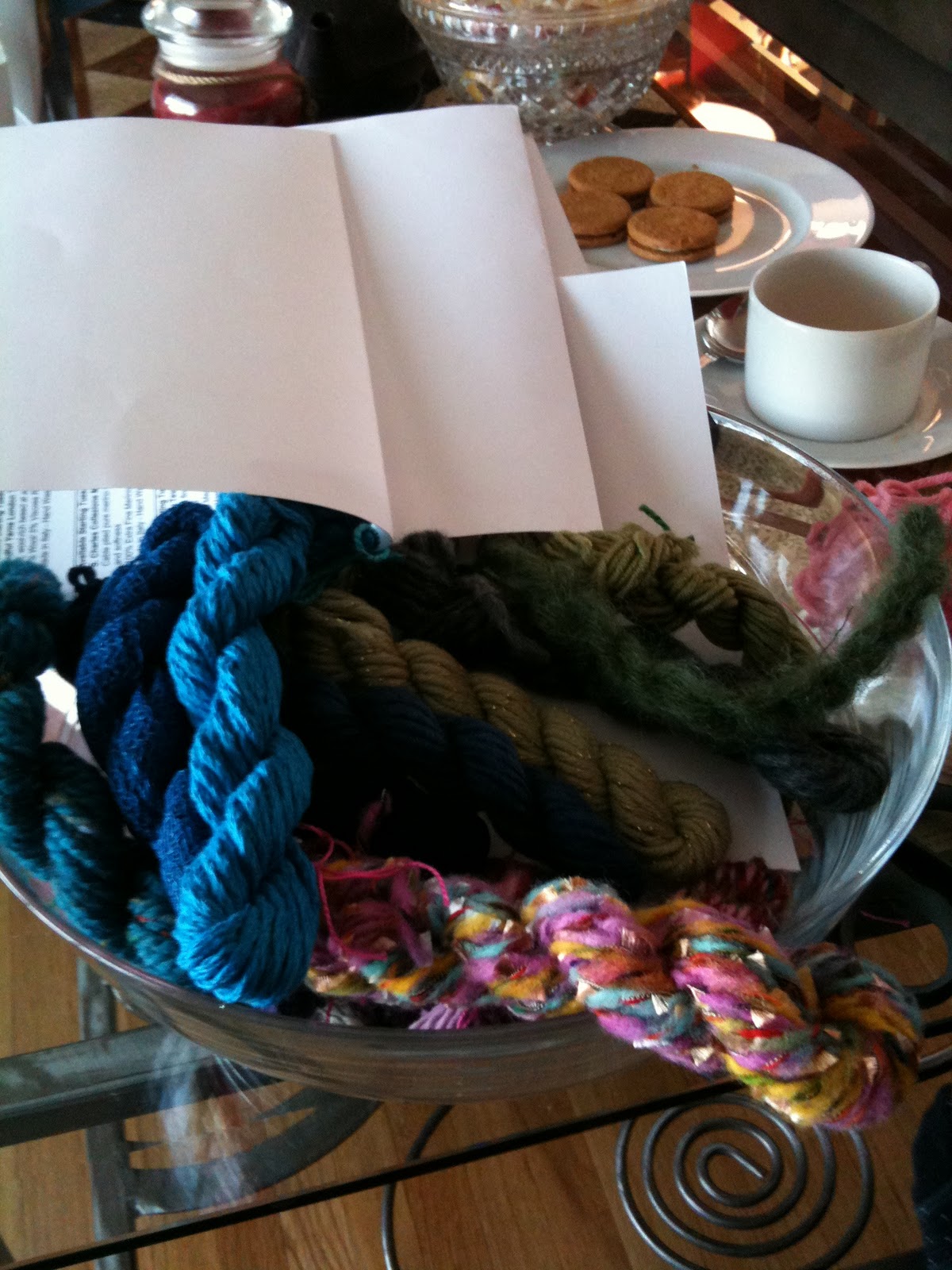
After a lovely chat over tea & cookies, we started the knitting lesson and covered cast-on's, the knit stitch, and adding new yarn. I wanted to make the lesson as entertaining as possible, so for yarn, I dug into my yarn samples stash. I highly recommend this idea! It is really fun to play with different colors and textures of yarn, using just a few yards at a time. It instantly makes the lesson very low-stress and personal, because a student can play with the yarn from the start.
A "new" knitter:
Fun with colors & textures:
After a lovely chat over tea & cookies, we started the knitting lesson and covered cast-on's, the knit stitch, and adding new yarn. I wanted to make the lesson as entertaining as possible, so for yarn, I dug into my yarn samples stash. I highly recommend this idea! It is really fun to play with different colors and textures of yarn, using just a few yards at a time. It instantly makes the lesson very low-stress and personal, because a student can play with the yarn from the start.
A "new" knitter:
Fun with colors & textures:
Wednesday, January 5, 2011
Sorry, Columbus, the world is actually flat
How do I know the world is flat? Because I fell off the edge of it for a little while. Between changes at work, family illnesses and surgeries, and the holidays, life has been a whirlwind and my blog was one of the casualties. But I'm back now! It's a new year, anything is possible, and maybe the world will prove itself to be spherical after all.
I haven't finished any spinning projects since I last blogged, although I have a few more singles spun during that time... but I'll catch up with spinning news in a later post, and I'll catch up now with other fiber news in my life for the last few months.
One great highlight is from November, 2010, when I visited Misty Meadow Icelandics sheep farm in Minnetrista, MN. The owners, Tom & Judy McDowell, are awesome people. Tom gave me a tour of their place, where I got to meet Judy in her felting studio, and then Tom took me to the sheep barn to meet the flock. We both have biology backgrounds and discussed sheep breeding and husbandry very happily for quite a while. Here's a photo I snapped of one of the back pens behind the barn. The smallest sheep in the photo, second from the left, is a young ram who will get to service the other three sheep, all of whom are mature ewes. The ewes weren't quite in their cycle yet, so it was pretty funny to see how strongly they rebuffed him at that time. He ended up looking quite disgusted with these three chicks who were big enough to boss him around and had no problem reminding him of that.
After visiting this farm, Icelandic sheep have moved to the top of my favorite breeds list, and I bought two fleeces from the McDowell's while I was there. This is a primitive or "unimproved" breed of sheep that are genetically almost identical to sheep from Iceland & the Viking era about 1,000 years ago. It makes them very interesting - both sexes have horns, they have lovely dual-coated fleeces in lots of natural colors, and the smarts haven't been bred out of them, so to speak.
In December, I did manage to complete one handmade gift for Christmas 2010. Our friend Ryan gets to enjoy a double knit, reversible hat, and I have to say, I absolutely love self-striping sock yarn!
In other Christmas news, I'm extremely lucky to have family who knows and loves me, because I received some great fiber related loot this year. My parents found a very neat knitting page-a-day calendar that offers patterns throughout the year:
My brother scored big sister points with a tahkli spindle (a steel & brass support spindle from India traditionally used to spin cotton), a ceramic spindle bowl, and 100 grams of cotton punis (pronounced Poo-nees), which are tightly wrapped rolls of unspun cotton fiber:
My sister- and brother-in-law found a gorgeous Lantern Moon basket, knitting needles, and beautiful silk & mohair yarn for me:
And my husband shocked me with a Strauch drum carder:
I anticipate many, many happy hours with my fiber art in 2011 and I can't wait to share my discoveries, frustrations, and successes with everyone. Happy New Year!
I haven't finished any spinning projects since I last blogged, although I have a few more singles spun during that time... but I'll catch up with spinning news in a later post, and I'll catch up now with other fiber news in my life for the last few months.
One great highlight is from November, 2010, when I visited Misty Meadow Icelandics sheep farm in Minnetrista, MN. The owners, Tom & Judy McDowell, are awesome people. Tom gave me a tour of their place, where I got to meet Judy in her felting studio, and then Tom took me to the sheep barn to meet the flock. We both have biology backgrounds and discussed sheep breeding and husbandry very happily for quite a while. Here's a photo I snapped of one of the back pens behind the barn. The smallest sheep in the photo, second from the left, is a young ram who will get to service the other three sheep, all of whom are mature ewes. The ewes weren't quite in their cycle yet, so it was pretty funny to see how strongly they rebuffed him at that time. He ended up looking quite disgusted with these three chicks who were big enough to boss him around and had no problem reminding him of that.
After visiting this farm, Icelandic sheep have moved to the top of my favorite breeds list, and I bought two fleeces from the McDowell's while I was there. This is a primitive or "unimproved" breed of sheep that are genetically almost identical to sheep from Iceland & the Viking era about 1,000 years ago. It makes them very interesting - both sexes have horns, they have lovely dual-coated fleeces in lots of natural colors, and the smarts haven't been bred out of them, so to speak.
In December, I did manage to complete one handmade gift for Christmas 2010. Our friend Ryan gets to enjoy a double knit, reversible hat, and I have to say, I absolutely love self-striping sock yarn!
In other Christmas news, I'm extremely lucky to have family who knows and loves me, because I received some great fiber related loot this year. My parents found a very neat knitting page-a-day calendar that offers patterns throughout the year:
My brother scored big sister points with a tahkli spindle (a steel & brass support spindle from India traditionally used to spin cotton), a ceramic spindle bowl, and 100 grams of cotton punis (pronounced Poo-nees), which are tightly wrapped rolls of unspun cotton fiber:
My sister- and brother-in-law found a gorgeous Lantern Moon basket, knitting needles, and beautiful silk & mohair yarn for me:
And my husband shocked me with a Strauch drum carder:
I anticipate many, many happy hours with my fiber art in 2011 and I can't wait to share my discoveries, frustrations, and successes with everyone. Happy New Year!
Tuesday, October 12, 2010
2010 Knit-Out!
This past Sunday, the Minnesota Knitter's Guild participated in National Knit-Out Day. We hosted the event at Southdale Mall and the festivities included a handmade knits fashion show, door prizes, and free knitting lessons to anyone who wanted them. I volunteered to be one of the teachers, and I'm not sure who learned more - me or my students. I've never taught knitting before, and I have to admit, I botched it with my first student. I was nervous and it showed. But I learned quickly from my mistakes and did just fine with my second student. By the time I had my third student, I was in a groove and felt pretty confident. The event was very well attended and I think everyone (except maybe my first student) had a great time.
Saturday, October 9, 2010
More spindle WIP progress
I switched gears from my mixed greens yarn project to my gossamer yarn project. Here's a summary of this yarn project to date... Detta gave me a sample of English Garden merino wool and I wanted to make the most of it, and I also wanted to try making a cabled yarn for the first time. Cabled yarn is the result of plying two or more plied yarns together. If you took four singles yarn and plied them together at the same time, the result is called a 4-ply yarn. But if you take those same singles and ply two of them together at a time, and then ply the two 2-ply yarns together, your result is called a 4-strand cabled yarn.
While this may seem like a small difference in making the final yarn, the structure of the yarns is very different. The 4-ply yarn is very smooth, with the individual strands lying next to each other and the surface reflects more light. A 4-strand cabled yarn is bumpier and has a pixelated effect. The colors of the yarn become dots throughout the yarn, and the reflective quality of the yarn is broken up. Here is a close-up of the yarn texture between 4-ply and 4-strand cable in a knitted sample:
Since I knew I wanted to make a 4-strand cable, I divided my sample into four sections and spun them separately. I spun the first section on my smallest spindle and decided that it would be a waste of time to wind that small amount of yarn on a bobbin and repeat that four times, so I then spun a short section of white wool to act as a divider between the first and second sections of the colored singles. Then I wound that single on a bobbin and spun the third and fourth singles with white wool in the middle to divide them. So I ended up with two bobbins that would allow me to easily ply two singles together:
So if I divided my sections evenly and spun them consistently, I will be able to ply the yarn from the two bobbins together and the white wool in the centers will match up to mark the division between the two 2-ply yarns. I've spun the first of the singles together and was very happy to see that my approach worked very well:
There was very little overlap of colored yarn to white yarn, and now I'll keep going until the bobbins are empty. When I wind the 2-ply yarn back on a bobbin, I'll fill the first bobbin until I reach the white wool. Then I'll break the yarn and wind the next section of colored 2-ply on the second bobbin. Finally, I'll be able to easily ply those two 2-ply yarns together to create the final 4-strand cabled yarn.
While this may seem like a small difference in making the final yarn, the structure of the yarns is very different. The 4-ply yarn is very smooth, with the individual strands lying next to each other and the surface reflects more light. A 4-strand cabled yarn is bumpier and has a pixelated effect. The colors of the yarn become dots throughout the yarn, and the reflective quality of the yarn is broken up. Here is a close-up of the yarn texture between 4-ply and 4-strand cable in a knitted sample:
Since I knew I wanted to make a 4-strand cable, I divided my sample into four sections and spun them separately. I spun the first section on my smallest spindle and decided that it would be a waste of time to wind that small amount of yarn on a bobbin and repeat that four times, so I then spun a short section of white wool to act as a divider between the first and second sections of the colored singles. Then I wound that single on a bobbin and spun the third and fourth singles with white wool in the middle to divide them. So I ended up with two bobbins that would allow me to easily ply two singles together:
So if I divided my sections evenly and spun them consistently, I will be able to ply the yarn from the two bobbins together and the white wool in the centers will match up to mark the division between the two 2-ply yarns. I've spun the first of the singles together and was very happy to see that my approach worked very well:
There was very little overlap of colored yarn to white yarn, and now I'll keep going until the bobbins are empty. When I wind the 2-ply yarn back on a bobbin, I'll fill the first bobbin until I reach the white wool. Then I'll break the yarn and wind the next section of colored 2-ply on the second bobbin. Finally, I'll be able to easily ply those two 2-ply yarns together to create the final 4-strand cabled yarn.
Wednesday, October 6, 2010
The fortune cookie was right!
Remember back in September, I had a fortune cookie predict that I would receive something nice in the mail? Well, friends, never never never doubt the power of fortune cookies. Do not tempt fate by even mocking them.
When I arrived home from work today, there was a large box by the door, which puzzled me. What the heck?, I thought. (Honest, that really was the 4-letter word I used mentally... it was a such tiring day at the office that I didn't even use a more inflammatory 4-letter word as I typically might have.) I figured my husband must have ordered something, but then I saw the box was addressed to me. Huh? What the...? And then I saw the box was shipped from 13 Mile Lamb & Wool Company and I spontaneously broke out into a big happy dance. Beautiful wool fleeces had arrived!!
I dragged the box inside to open it. The dogs found it pretty fascinating, too, enough to even drop the toy they had been playing with next to the box. This isn't the best picture, since Maddy moved and is a bit blurry, but you had to see the size of this box!
And here is my loot - over 20 pounds of raw organic fleeces raised in Montana on a predator-friendly ranch. I love the natural colors - black, white, moorit & grey. I am in wooly goodness heaven.
Oliver was fascinated by the sheepy fragrance and kept sticking his face in the fleece bags. Here he is examining the moorit fleece. He was quite serious about thoroughly performing his quality control work.
I cannot wait to get to work on these fleeces! Behold the power of wool: my day went from tiring/boring/blah to happy dance/joy/anticipation in mere seconds.
When I arrived home from work today, there was a large box by the door, which puzzled me. What the heck?, I thought. (Honest, that really was the 4-letter word I used mentally... it was a such tiring day at the office that I didn't even use a more inflammatory 4-letter word as I typically might have.) I figured my husband must have ordered something, but then I saw the box was addressed to me. Huh? What the...? And then I saw the box was shipped from 13 Mile Lamb & Wool Company and I spontaneously broke out into a big happy dance. Beautiful wool fleeces had arrived!!
I dragged the box inside to open it. The dogs found it pretty fascinating, too, enough to even drop the toy they had been playing with next to the box. This isn't the best picture, since Maddy moved and is a bit blurry, but you had to see the size of this box!
And here is my loot - over 20 pounds of raw organic fleeces raised in Montana on a predator-friendly ranch. I love the natural colors - black, white, moorit & grey. I am in wooly goodness heaven.
Oliver was fascinated by the sheepy fragrance and kept sticking his face in the fleece bags. Here he is examining the moorit fleece. He was quite serious about thoroughly performing his quality control work.
I cannot wait to get to work on these fleeces! Behold the power of wool: my day went from tiring/boring/blah to happy dance/joy/anticipation in mere seconds.
Monday, October 4, 2010
Spindle WIPs - Progress with "mixed greens" yarn
I'm making progress on my goal of completing all spindle WIPs before I can start any new yarn! For my "mixed greens" yarn, I've spun all the singles and tonight I wound them on to bobbins (note there are no overloaded bobbins... I have thoroughly learned that lesson). While winding the yarn on the bobbins, I noticed my spindle spinning skill has definitely improved in the last few months. The moss yarn, which was spun in July, might give me a bit of trouble during plying. While its thickness is consistent, I have better learned how monitor the amount of twist in my singles. I'm pretty sure there are some under-twisted lengths of yarn in the moss singles, but hopefully it won't fall apart during plying. We shall see.
Subscribe to:
Posts (Atom)